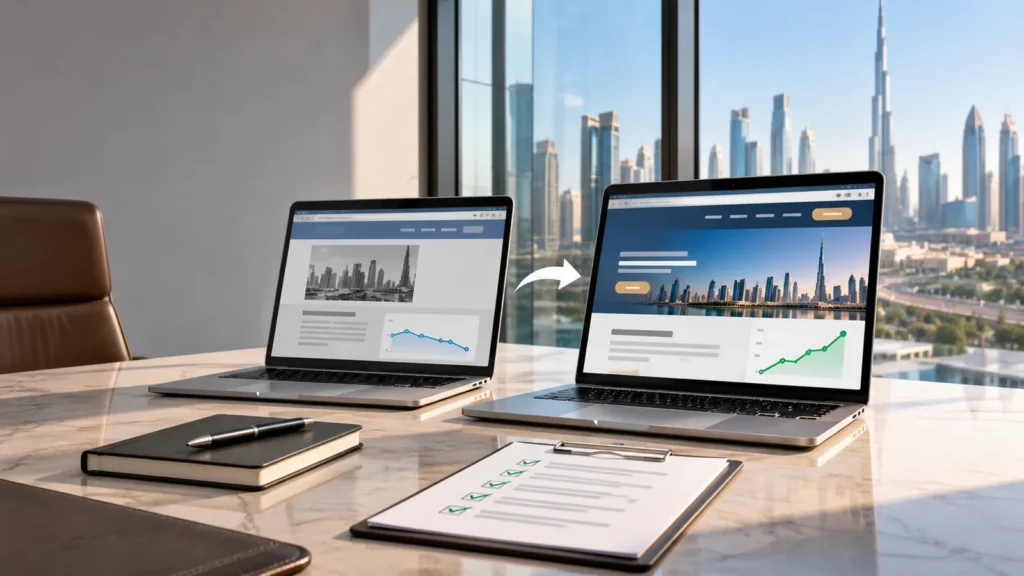
Website redesign SEO in Dubai is more than keeping your keywords in the right places. When a company rebuilds its website, it needs to protect the service pages, helpful content, internal links and customer journeys that allow people to find—and contact—the business.
Imagine a fictional Dubai facilities company replacing an older WordPress website with a modern design. The new site looks professional, but its best-performing services receive different addresses, useful articles disappear and staging settings accidentally block indexing. The design has improved; the path from Google Search to an enquiry has not.
Google’s site-move guidance recommends preparing and testing the new site, mapping old URLs to relevant replacements, implementing redirects when addresses change and monitoring the move. It also cautions that significant migrations may cause temporary search fluctuations.
This guide explains 15 checks for Dubai businesses rebuilding a WordPress site, moving to Shopify or improving existing pages. It distinguishes a visual redesign from a migration that changes URL addresses. Nobody can promise identical rankings after every redesign, but an organised process reduces avoidable mistakes.
First decide: is this a visual redesign or a site migration?
A new colour palette, cleaner navigation or different page template does not automatically require a new address for every page. If the existing domain and URL paths can remain stable, preserve them while improving usability and the content itself. A domain switch, major permalink restructure or a move between content management systems can be a true migration and requires more technical planning.
Google distinguishes hosting changes without URL changes from moves involving different addresses. Do not combine a domain move, a complete rewrite and a platform change on the same day when these tasks can be separated. Sometimes the sensible option is to fix the existing website rather than replace it. For broader budget considerations, see the GWS guide to website costs in Dubai.
Check 1: Record traffic, rankings and real enquiries
For website redesign SEO in Dubai, establish a baseline before anybody alters the site. Export top landing pages, clicks, impressions and important search queries from Google Search Console across comparable reporting periods, such as 28 and 90 days where data is available. Capture performance for the pages that generate meaningful business, not only the homepage or the articles with the highest traffic.
In analytics and your sales system, record verified form submissions, connected calls, received WhatsApp messages and qualified enquiries separately. A click on a WhatsApp button does not prove a conversation was received. Save existing page screenshots, metadata and mobile layouts as well. When enquiries change after launch, this baseline helps distinguish lost search traffic from a broken form or a difference in tracking.
Check 2: Crawl and inventory every existing URL
Export a complete URL list using a crawler and the current XML sitemap. Cross-check it against Search Console landing pages, analytics, server logs if available, and any archived content list. Include service pages, blog posts, portfolio examples, products, PDFs and valuable image resources. A page can receive visits from Google even when it is not linked from the main menu.
Create a migration sheet with the old URL, page topic, current status code, canonical address, proposed new URL, keep/merge/remove decision, redirect requirement, priority and test result. Identify the owner of that sheet. It will become the basis for launch testing and post-launch repairs. Do not assume that a new sitemap automatically preserves everything worth retaining.
Check 3: Identify your strongest pages and backlinks
Prioritise existing pages that attract relevant visitors, earn trustworthy incoming links or bring genuine customer enquiries. A detailed service article may look less fashionable than a new full-screen hero, but removing it can make the business harder to discover and understand. Preserve useful content, case studies and download links unless you have a clear reason to consolidate or retire them.
For a Dubai business, also check accurate company details and landing-page links on its eligible Google Business Profile, business directories and social profiles. Do not create duplicate profiles just because the website is being redesigned. Keep a record of valuable external links that may need updating. Our Local SEO Packages Dubai guide discusses the wider importance of local business information.
Check 4: Keep valuable URLs unchanged where possible
One practical rule of website redesign SEO in Dubai is to avoid changing established URLs without a reason. Every change creates work for users, bookmarks, internal links and search engines. When a useful service page can keep its existing slug, there is usually no SEO reason to rename it solely because the page layout changes. Check WordPress permalink settings, custom post types and key page slugs before replacing a theme or changing builders.
If the site moves from WordPress to Shopify, research the new platform’s supported paths in advance. Product, collection, page and blog addresses may follow different conventions. Some changes will be unavoidable, but they should be documented rather than discovered after launch. Make every URL change a deliberate editorial and technical decision, not an automatic side effect of a template update.
Check 5: Preserve content, intent and metadata
A redesign should make useful information easier to read, not erase it. Retain accurate descriptions of what the company does, whom it serves, service areas, common questions and what a customer can expect after enquiring. Replacing several detailed paragraphs with an unsubstantiated “best company in Dubai” slogan is not a meaningful content improvement.
Review important pages’ SEO titles, primary headings, relevant subheadings, descriptions, canonical addresses, image ALT text and internal links. You may improve weak content, but document large changes so later performance shifts can be investigated. For genuine English and Arabic alternatives, retain distinct translated content and follow Google’s guidance on localized page versions where appropriate. Language markup must match pages that actually exist.
Check 6: Keep staging private and remove launch-day blocks
Build and test the new site in a staging environment before it replaces production. Protect staging with authentication where practical, especially if the copy contains customer information, forms or unapproved material. An openly crawlable duplicate of the live site is not a suitable long-term staging arrangement.
If you use a noindex rule on crawlable staging pages, confirm that it is removed from production on launch day. Google’s noindex guidance explains why a robots.txt block can prevent Google from seeing a page-level noindex directive. These controls have different functions and should not be confused. Prepare a written release checklist covering passwords, robots instructions, indexing settings and canonical tags. Test them on the public live URL, not only in the administrator preview.
Check 7: Map every changed URL to a useful destination
In website redesign SEO in Dubai, every URL that changes should point to a genuinely relevant new destination. For example, a fictional old page about commercial air-conditioning maintenance should lead to the new page covering that service. A blog guide should redirect to its updated version or the closest equivalent—not automatically to the homepage.
Google warns that sending many unrelated old URLs to a single irrelevant page may be interpreted as a soft 404. A page that is permanently removed and has no appropriate replacement may be better served by a proper 404 or 410 response. Include slash variants, uppercase paths and important query parameters in your tests where relevant. Have both the developer and SEO lead approve the URL mapping before deployment; otherwise redirects can appear technically successful while delivering visitors to the wrong content.
Check 8: Implement and test permanent redirects
When an old page permanently moves, a server-side 301 or 308 redirect is generally appropriate. Google says permanent redirects signal that the destination should be considered the canonical new address. See its redirect documentation for the distinction between permanent and temporary redirects.
Test each important old URL from a fresh browser session or HTTP checker and confirm that it reaches the correct final page. Avoid redirect loops, unnecessary chains and destinations that produce errors. Google’s migration guidance generally recommends keeping redirects for at least one year; keeping them longer may help people with old bookmarks and external links. After launch, update internal links to their final destinations rather than making every visitor pass through a redirect.
Check 9: Check canonical tags and indexability
A common website redesign SEO in Dubai risk is a page that looks correct while its technical settings tell Google that a different URL is preferred. Check that production pages return suitable HTTP status codes, are indexable where intended and use appropriate self-referencing or other justified canonical URLs. The new service page should not accidentally point its canonical at staging or an unrelated older URL.
Google describes redirects, rel="canonical" and sitemap inclusion as different canonicalization signals, not absolute guarantees. Its canonicalization documentation explains how they can support one another. Check HTTPS and hostname variants, duplicate parameter pages and multilingual alternatives. Do not apply a blanket noindex rule to important public pages merely to silence a canonical warning. After launch, use URL Inspection where needed to investigate Google’s actual selected canonical.
Check 10: Rebuild internal links and navigation
A menu is not the whole internal linking strategy. Existing blog articles and service descriptions may connect customers to related information, project examples and enquiry forms. Those contextual routes can disappear when a developer rebuilds a template or copies only the top-level navigation into a new design.
Replace internal links that still point to old addresses with direct links to the final URLs. Review navigation, footers, image links, mobile menus and CTAs. A useful redesign article naturally leads to GWS website development and SEO and content marketing services, not an unrelated collection of pages. Use clear, varied link text. Linking should help a visitor continue their journey, not simply increase the number of exact-match keywords on a page.
Check 11: Test mobile design and Core Web Vitals
Every website redesign SEO in Dubai checklist should include testing representative pages at 360 and 390 pixels and on a real phone where possible. Check that headings wrap correctly, menus open, images remain within the content width and forms are usable. A sticky WhatsApp or call bar must not obscure the main enquiry button, cookie controls or the end of the form. If the business has English and Arabic pages, test both languages rather than assuming the same layout works automatically.
Use PageSpeed Insights to test the homepage, a service page, a blog article and a contact or lead-generation page. Examine loading performance, responsiveness and layout stability, including real-user Core Web Vitals where the data is available. Prioritise large images, unnecessary scripts, delayed fonts and page elements that jump during loading. A perfect laboratory score is not proof that customers can complete a real enquiry.
Check 12: Verify forms, calls, WhatsApp and tracking
Website redesign SEO in Dubai also requires an end-to-end enquiry check: do not approve a redesigned site merely because its homepage looks correct. Submit test enquiries from each main form and confirm that the right team receives the correct details. Verify validation messages, submission confirmations, consent information, CRM field mapping and follow-up ownership. Test telephone links and WhatsApp buttons on mobile and desktop.
Keep analytics honest: a WhatsApp button click is not evidence of a received message, and a form view is not a successful submission. Compare old and new event definitions to avoid treating a tracking change as a change in business demand. Our Google Ads landing-page guide explains how on-page conversion issues arise, while our CRM automation guide covers what happens after enquiries arrive.
Check 13: Check sitemaps, robots rules and schema
As part of website redesign SEO in Dubai, prepare a production XML sitemap containing the intended canonical, indexable URLs. Remove outdated staging addresses, irrelevant duplicate pages and URLs that no longer exist. Submit the new sitemap to Google Search Console after launch. A submitted sitemap can help discovery; it does not guarantee that Google will index every page.
Inspect live robots.txt and page-level indexing rules, not just the configuration in WordPress. Check important templates for accurate structured data such as Article, BreadcrumbList or Organisation markup where appropriate. The markup should reflect real visible content, not fabricated reviews or promises. Confirm that important image files and documents still load. If the site supports translated pages, check that alternate-language references point to the correct URLs and remain consistent with canonical settings.
Check 14: Run a launch-day crawl and fix errors
Once the replacement site is live, visit it in an ordinary browser without an administrator session. Confirm the intended domain and HTTPS, open key service pages, test the navigation and submit genuine test enquiries. Run a fresh crawl of the public site and compare its pages with the old URL inventory and the approved migration map.
Inspect redirect destinations for wrong pages, loops and unnecessary chains. Look for empty page templates, missing titles, broken images, incorrect canonicals, lingering noindex restrictions and links still pointing to staging. Update paid advertisements, social profiles and business listings that use old addresses. Maintain a current backup and a named person responsible for urgent fixes. A successful launch means that customers and search engines can reach the intended content, not simply that the deployment completed.
Check 15: Monitor indexing and qualified leads
After launch, compare Search Console data and verified enquiries against the baseline. Review page-level clicks, impressions and important queries alongside indexing, redirect errors, missing pages and Google-selected canonical addresses. Significant URL migrations can cause temporary changes while Google recrawls the new pages, but persistent problems should be investigated rather than dismissed as normal.
Look for patterns in the pages that matter to the business. A sudden change to one service page after its URL moved suggests checking its redirect, content, canonical, indexing rules and internal links. A broad drop may also reflect seasonality, changes in demand or altered analytics settings. Track confirmed enquiries and qualified sales opportunities rather than button clicks alone. The purpose of website redesign SEO in Dubai is sustained discoverability and a reliable journey towards customers—not a promise of fixed rankings.
Illustrative WordPress-to-Shopify migration example
Consider a fictional Dubai gift supplier changing from WordPress to Shopify. Its current site has a product-category page at /gift-boxes/, a customer guide at /blog/corporate-gifts/ and a commercial gifting service page. Shopify may use different URL structures for collections, products, pages and blogs, so the team must check which legacy addresses can be preserved and which require redirects.
Before switching the domain, match each old page to the closest suitable new page. Preserve essential guidance and relevant product information, test the redirect from the old URL, check canonical tags and confirm that links from advertising, directories and other websites still lead somewhere useful. A discontinued product with no suitable replacement may require a valid not-found response rather than an irrelevant homepage redirect. These addresses are illustrative and are not GWS customer data or a guaranteed search outcome.
Website Redesign SEO in Dubai: Pre-launch and post-launch checklist
Before development
- Agree whether the project changes page addresses, hosting, content or only design.
- Export traffic, important queries, page lists and confirmed enquiries.
- Review useful pages, backlinks, local business details and language versions.
- Approve the keep, merge, remove and redirect decisions.
Before the live switch
- Test the staging site, responsive design, content and forms.
- Verify the redirect map, canonicals, titles, internal links and schema.
- Check sitemap contents, privacy settings and production indexing controls.
- Agree a launch owner, backup and rollback process.
After launch
- Crawl the public site and check high-value old URLs.
- Inspect Search Console indexing, errors and canonical selection.
- Confirm received messages and qualified enquiries, not only clicks.
- Keep the URL map and redirects and record outstanding fixes.
Frequently asked questions
Will redesigning my website affect my Google rankings?
It can, particularly if valuable URLs, content or indexing settings change. A careful redesign can reduce avoidable risks, but no agency can guarantee unchanged rankings.
Do I need 301 redirects if every URL stays the same?
No. Redirects are appropriate for pages that actually move or are consolidated. A purely visual redesign does not require unnecessary URL changes.
How long will Google take to process a site migration?
There is no fixed period. Google’s guidance says small and medium-sized sites can take weeks, while larger moves may take longer. Monitor individual pages and investigate technical problems.
Can I move from WordPress to Shopify without losing SEO?
You can reduce risk by preserving useful content, mapping URLs, configuring redirects, testing internal links and monitoring the move. Shopify may use different URL structures, and rankings cannot be guaranteed.
Should my staging website be blocked from search engines?
Keep unfinished staging material private where practical. Authentication is useful; if you rely on noindex or robots rules, understand their different behaviours and remove staging restrictions from production.
What should I check first if enquiries fall after the redesign?
Check whether the forms, phone links and messaging workflows still work and whether tracking is accurate. Then examine traffic to affected pages, redirects, indexing, content and mobile usability.
Protect your search visibility while improving the website
A redesign should improve the customer’s experience without unnecessarily discarding the pages, search signals and internal connections that the business has already built. The strongest projects agree on what to preserve before development, then verify the migration publicly before calling it complete.
These 15 checks make website redesign SEO in Dubai a manageable process, from the first URL inventory to the post-launch search and enquiry review. They also help business owners ask developers and agencies for specific evidence rather than vague promises that nothing will change.
Grow With Shuraim supports website development, SEO and content marketing and lead generation. If your company is considering a redesign or CMS move, contact GWS about a pre-launch SEO and enquiry-tracking review.