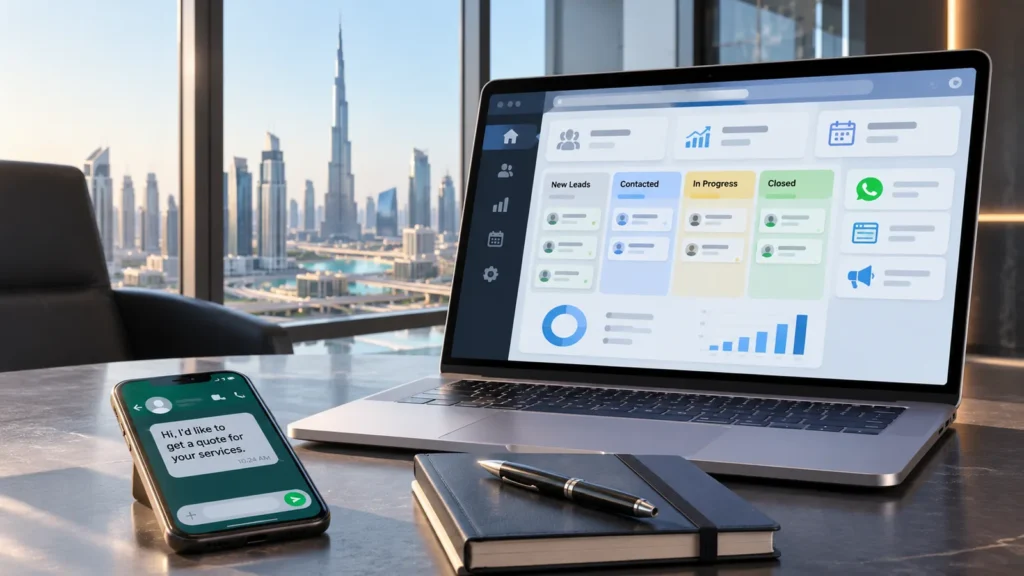
CRM automation in Dubai should do more than send an instant reply. Imagine paying for a promising enquiry through Google Ads, receiving a website form at lunchtime and discovering two days later that nobody followed up. The problem was not a lack of leads; it was a missing handover.
That can happen across WhatsApp, Facebook and Instagram lead forms, Google Ads, email and website enquiries. Each channel may work individually while the overall sales process remains fragmented.
In this 2026 guide, we explain how to build a sensible CRM workflow for a Dubai business: collect verified enquiries, assign responsibility, use permitted follow-ups, connect marketing sources where possible, and report on genuine outcomes rather than superficial clicks. You do not need to buy expensive software before you understand the process you want to improve.
Why businesses in Dubai lose enquiries after paying for them
A lead rarely disappears because a business deliberately ignores it. More often, the enquiry arrives on a busy day through a channel that nobody owns. A website form goes to an email inbox, an Instagram message waits for a colleague who is off duty, and a WhatsApp conversation stays on one employee’s phone. Marketing reports a lead; sales cannot confirm what happened next.
That gap is expensive even when the adverts themselves are working. If you cannot connect the original enquiry to a person, follow-up action and sales outcome, you cannot tell whether you need more advertising budget or a better internal process.
A practical CRM automation in Dubai project should therefore begin with a simple question: “When someone contacts us, who is responsible for what happens next?” The right answer is a documented workflow, not just a chatbot.
Our guide to generating leads in Dubai looks at attracting enquiries. This article concentrates on keeping them visible and progressing them after they arrive.
What is CRM automation, and what should it actually do?
A customer relationship management (CRM) system stores and organises interactions with prospects and customers. Automation adds rules that move information and tasks between systems when an event happens. For example, a real form submission can create a lead record, assign a salesperson and set a reminder without someone copying details manually.
Useful CRM automation usually involves five connected responsibilities: capture, verify, assign, follow up and report. It should also make exceptions obvious. If an integration fails, a lead is duplicated or a salesperson is unavailable, someone needs an alert and a recovery process.
Automation does not replace relationship-building. It should remove repetitive administration so the sales team can spend more time understanding the buyer, preparing a suitable quotation and responding clearly.
A small Dubai company may need only a shared pipeline and two reliable automations. A larger sales operation might need multiple teams, approvals, integrations and a custom CRM. Choose based on operational complexity rather than the number of features advertised.
Connect website forms, ads and WhatsApp to one lead pipeline
For CRM automation in Dubai, the most useful design is one lead record with a clear history, regardless of where the initial enquiry started. Sources can include a contact form, Meta Instant Form, Google Ads landing page, direct WhatsApp message, telephone call or referral.
For website forms, capture the real submission event, the form name, date and intended service. Where permitted, preserve campaign information such as UTM parameters and available Google Ads identifiers. For advertising platform lead forms, use approved integrations or APIs with appropriate account permissions. A platform click alone is not always a submitted or received lead.
WhatsApp needs special care. Clicking a WhatsApp button does not establish that a message was actually sent. A basic WhatsApp Business app cannot automatically provide every conversation event to an arbitrary CRM. Use an authorised WhatsApp Business Platform integration when event-level synchronisation is needed, or keep a disciplined manual record when the business is not ready for that setup.
We explain this distinction in our existing WhatsApp lead tracking guide for Google Ads. The CRM should preserve unknown attribution rather than guessing which ad produced a conversation.
At minimum, a new record should have an internal lead ID, source where known, enquiry type, received timestamp, assigned owner, current status and next action. Avoid collecting personal details that are not necessary to handle the enquiry.
An example: from a new enquiry to a properly followed-up sale
Imagine a Dubai facilities company running Google Ads and a website contact form. A potential customer requests a maintenance quotation at 6:40 pm. The example below is an illustrative workflow, not a claim about actual GWS client results.
- Receive: The form passes validation and the system creates a record with a unique reference.
- Check: The CRM looks for an existing matching enquiry and avoids creating a second open deal when it is a duplicate.
- Assign: The record goes to the relevant team or the next available person. It also records who is responsible.
- Acknowledge: The customer receives an appropriate confirmation through a permitted channel, with the expected response window.
- Act: The owner is notified, sees the request and has a defined next step. Urgent requests can have their own routing rule.
- Escalate: If the enquiry remains untouched beyond the agreed internal response target, a manager receives an alert.
- Qualify: A real employee confirms the service, location, budget suitability and timeframe rather than assuming that a form fill is a qualified buyer.
- Close the loop: The outcome is recorded as quoted, won, lost or not qualified, with relevant evidence and a reason where possible.
This flow is more useful than a generic “instant reply” promise because every stage has an owner and can be checked. A CRM should never automatically move an enquiry to “Paid” simply because it received a WhatsApp message.
Build sensible follow-up rules and human handover
For CRM automation in Dubai to be useful, follow-ups must be relevant and expected. Set a clear acknowledgement, then a realistic task for an employee. For example, an office-hours enquiry might be assigned for review that same working day, while a late-night enquiry could receive a polite receipt and be scheduled for the next staffed period. These are configurable service standards, not industry-wide response-time guarantees.
Useful reminders include “customer requested a call”, “quotation sent but no response”, “appointment is tomorrow” and “service completed; request feedback when appropriate”. Stop or change the sequence when a person replies, declines messages, books or purchases. Do not let multiple workflows send contradictory follow-ups.
On the WhatsApp Business Platform, replies within the customer-service window and business-initiated messages have different rules. WhatsApp’s business messaging policy describes the 24-hour customer-service window, approved message templates outside it, opt-in expectations and a route to human assistance. A normal phone app, an approved API and a bulk-messaging tool are not interchangeable.
Keep the handover explicit. The team should be able to see the enquiry context, accept responsibility, override an inappropriate automation and resume a real conversation. That is particularly important for high-value B2B proposals where buyers expect a thoughtful reply rather than a scripted sequence.
WhatsApp Business, off-the-shelf CRM or custom system?
Choosing CRM automation in Dubai does not always mean buying software. For a solo consultant, the WhatsApp Business app, a small contact log and calendar reminders may be enough. For a team handling enquiries from several sources, a shared CRM with access controls and a clear pipeline becomes more valuable.
Off-the-shelf tools such as HubSpot, Zoho or another suitable CRM can be sensible when their standard stages, reporting and integration options meet your requirements. Compare the total cost of licences, messaging, implementation, training and support rather than only the advertised subscription price.
A custom CRM makes sense when your process genuinely needs specialised permissions, multi-step quotation workflows, multiple brands or integrations unavailable in standard products. But custom development also creates maintenance, testing, security and documentation obligations. It is not automatically the cheapest long-term choice.
For reliable CRM automation in Dubai, start with one working pipeline and add features after staff have demonstrated that they will use it. GWS’s lead generation services and email and WhatsApp marketing services provide relevant starting points for mapping connected customer journeys.
Where n8n fits into a practical CRM automation workflow
n8n is a workflow automation platform that can connect supported services through APIs and webhooks. It can help pass validated form submissions into a CRM, notify the lead owner, create scheduled follow-up tasks and send authorised status changes to a reporting system.
One practical CRM automation in Dubai workflow might be: website form → validated webhook → deduplication check → CRM lead record → team notification → follow-up task. Each step needs sensible error handling, credentials kept outside public content, and logging that does not reveal unnecessary personal data.
Before moving to production, use test records to simulate missing fields, duplicates, wrong phone numbers, expired credentials and temporary API failures. Set up failure notifications and a queue or replay method where appropriate. An automation that silently drops a lead is worse than a visible manual process.
Use n8n or another connector because it fits your systems, not because it is fashionable. Where the CRM already includes a dependable native integration, an extra automation layer may add complexity without delivering value.
Define useful CRM stages and clear qualification criteria
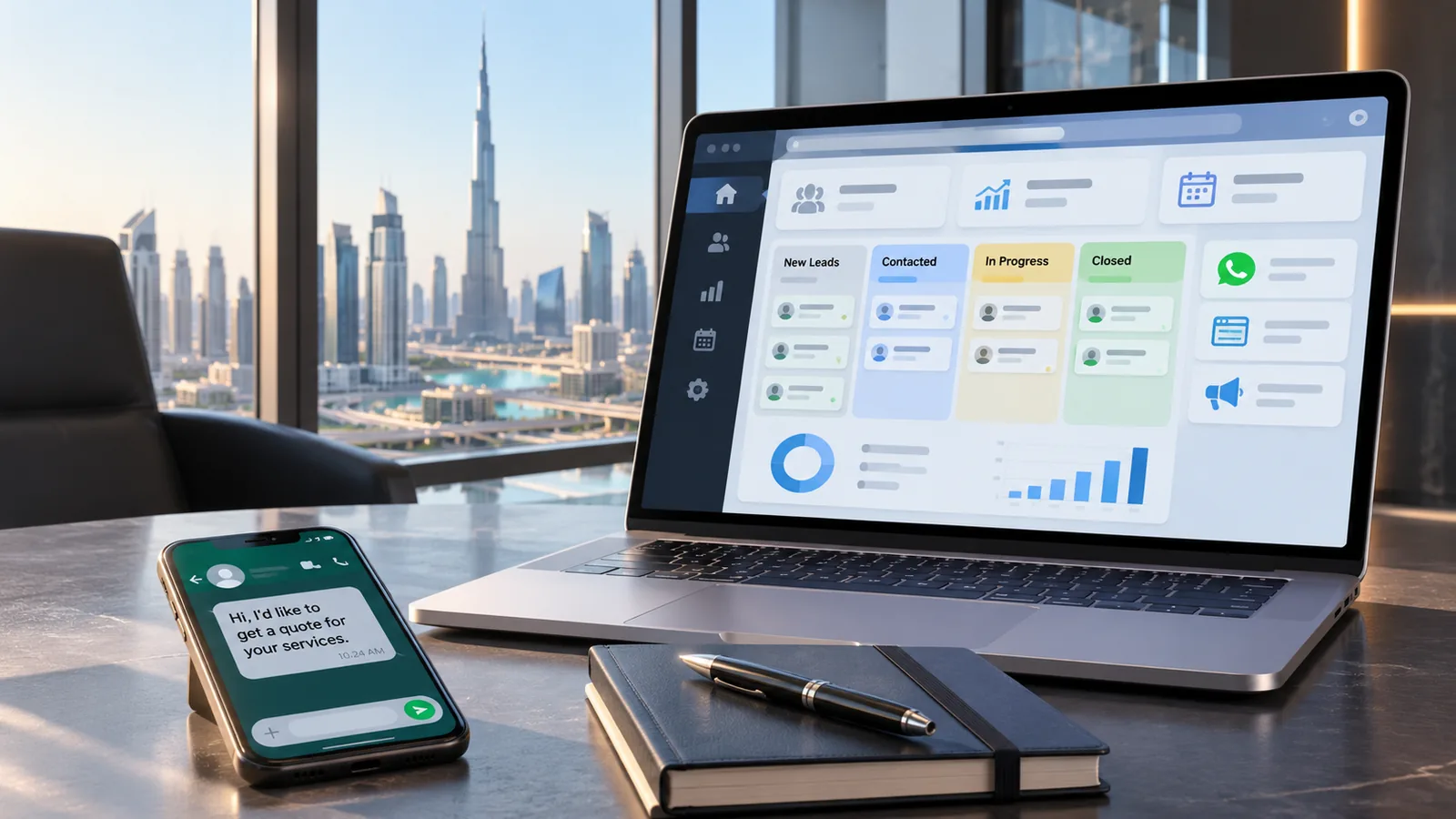
Too many pipeline columns make reporting confusing. Start with stages that reflect genuine business decisions: New enquiry, Received, Contacted, Qualified, Quoted, Won, Lost. Keep a separate “Unverified” status for situations where a click has been recorded but an incoming message or form submission has not been confirmed.
Write one short definition for each status. A lead is “Qualified” only when it matches agreed business-fit criteria, such as service requirement, location, project scope and next step. “Quoted” means a real proposal was sent, not merely that somebody opened a message. “Won” should follow a verifiable commercial outcome.
Record why relevant opportunities fail to progress: no response, wrong service, unsupported area, timing mismatch or price objections. Avoid vague labels based on personal characteristics. These reasons reveal problems that marketing and sales can improve together.
Ownership matters as much as classification. Each open record needs one accountable person and a next-action date. If the owner is on leave, a reassignment rule should prevent the opportunity from waiting indefinitely.
Measure qualified enquiries, response times and real sales
Measure the success of CRM automation in Dubai with definitions that everybody understands. Useful measures include confirmed received enquiries, share assigned to an owner, time until first meaningful response, percentage contacted, qualified leads, quotations, customers and unresolved records.
Review performance by source only where attribution is supported by evidence. A WhatsApp button click, a received message, a qualified enquiry and a paying customer are four different events. Reporting them as though they were identical will distort the budget decisions you make later.
For example, imagine a fictional campaign with AED 2,000 in spend, 40 form or messaging interactions, 20 confirmed enquiries and eight qualified leads. The advertising cost is AED 50 per interaction, AED 100 per received enquiry and AED 250 per qualified lead. These are illustrative arithmetic figures, not GWS campaign benchmarks.
Where your team captures verified offline outcomes, Google’s conversion guidance describes qualified-lead and offline conversion workflows. New integrations should consider the Google Data Manager API, subject to account setup, permissions, consent and matching requirements. Do not upload fabricated click IDs or treat every CRM status change as an attributable advertising conversion.
Privacy, consent and security for UAE lead automation
CRM automation in Dubai can involve customer names, contact details and conversation histories — all personal information. A CRM automation project should be designed around permitted purposes, a suitable legal basis, security controls and sensible retention, not just convenience.
The UAE Government’s data protection guidance explains the framework established by Federal Decree-Law No. 45 of 2021. The precise requirements depend on the type of organisation, processing activity and any applicable sector or free-zone regime, so seek qualified advice where necessary.
Operational safeguards should include role-based access, protected credentials, clear privacy notices, audit logs, prompt opt-out handling and a process for correcting or deleting data when required. Do not send full WhatsApp messages, phone numbers or other identifying details into public analytics event parameters.
Marketing permission is not a blanket licence to send repeated messages. Document the purpose of contact, honour unsubscribes and follow the platform’s current messaging rules. Keep automation transparent: a customer should be able to reach a person when needed.
What does CRM automation in Dubai cost?
There is no universal price for CRM automation in Dubai because the work can range from a simple form-to-sheet connection to a deeply integrated sales platform. A responsible quotation starts with the number of channels, users, message volume, required CRM functions, data quality, reporting and security requirements.
Ask each provider to separate one-time discovery and implementation from recurring software licences, WhatsApp Business Platform fees where applicable, hosting, support, maintenance and future changes. Confirm who owns the accounts and customer data, whether documentation is included, and what happens if you change providers.
Be cautious of comparisons that ignore human training or the cost of fixing broken integrations. A cheap system nobody uses can become more expensive than a smaller, well-supported workflow. For budgeting, compare proposals against the work actually required rather than an unsupported “typical Dubai price”.
A practical seven-day CRM automation audit
- Day 1 — Map sources. List all website forms, numbers, ad lead forms, inboxes and referral channels. Identify who currently sees each enquiry.
- Day 2 — Define a lead. Agree what counts as a click, a received enquiry, a qualified opportunity, a quote and a sale.
- Day 3 — Check capture. Send test submissions through each channel. Confirm arrival, record ID, attribution where available and duplicate handling.
- Day 4 — Check ownership. Verify that every new lead has a named owner, response standard and backup when the owner is unavailable.
- Day 5 — Test follow-up. Check acknowledgement wording, manual handover, timing, opt-out and whether reminders stop after a response.
- Day 6 — Review failures. Simulate a disconnected API, missing field and delayed message. Make sure errors become visible alerts.
- Day 7 — Compare outcomes. Match real received enquiries against qualified leads, quotations and sales. Prioritise the largest verified gap.
This CRM automation in Dubai checklist is a way to assess readiness, not a promise that a production CRM integration can be fully built in seven days. Larger implementations may require several stages of engineering, security checks and staff training.
Frequently asked questions about CRM automation in Dubai
Can CRM automation connect Google Ads, Meta Ads and WhatsApp?
Yes, when the relevant platforms, account permissions and approved integrations support the required events. A click or page visit should not be logged as a received WhatsApp conversation without separate evidence.
Do I need the WhatsApp Business Platform API for automated CRM messages?
For supported two-way event integration and automated messaging at scale, the authorised Business Platform is often appropriate. A standard WhatsApp Business app has different capabilities and should not be assumed to offer the same API access.
Will CRM automation replace my salesperson?
It should not. Automation handles repetitive routing, reminders and record updates. Human staff remain responsible for meaningful qualification, quotations, negotiation and sensitive situations.
Can I start with Google Sheets instead of paid CRM software?
For a small team, a well-controlled shared sheet may be a practical first step. It still needs clear ownership, reliable updates, access restrictions, backup and an agreed migration approach as complexity grows.
How should we measure whether the automation is working?
Compare confirmed incoming enquiries with assigned, contacted, qualified, quoted and won records. Check response times and error rates. Report attribution only where you can substantiate the link to a marketing source.
Is CRM automation compliant with UAE privacy rules?
It can be designed to meet applicable requirements, but installing a CRM or using an official messaging API does not automatically make every use compliant. Review your legal basis, transparency, consent where needed, retention and platform rules.
Stop paying for leads that vanish between marketing and sales
A successful lead-generation campaign is only the beginning. If a genuine enquiry has no owner, no next step and no reliable outcome record, the business is losing information as well as opportunities.
The strongest CRM automation in Dubai is not the most elaborate system. It is the one your team can trust: enquiries arrive in the right place, follow-ups happen when appropriate, and management can distinguish activity from qualified demand and revenue.
Grow With Shuraim helps businesses connect websites, campaigns, lead management and practical marketing workflows. Explore our lead-generation services, or contact GWS to discuss an audit of how your enquiries are captured and followed up.